
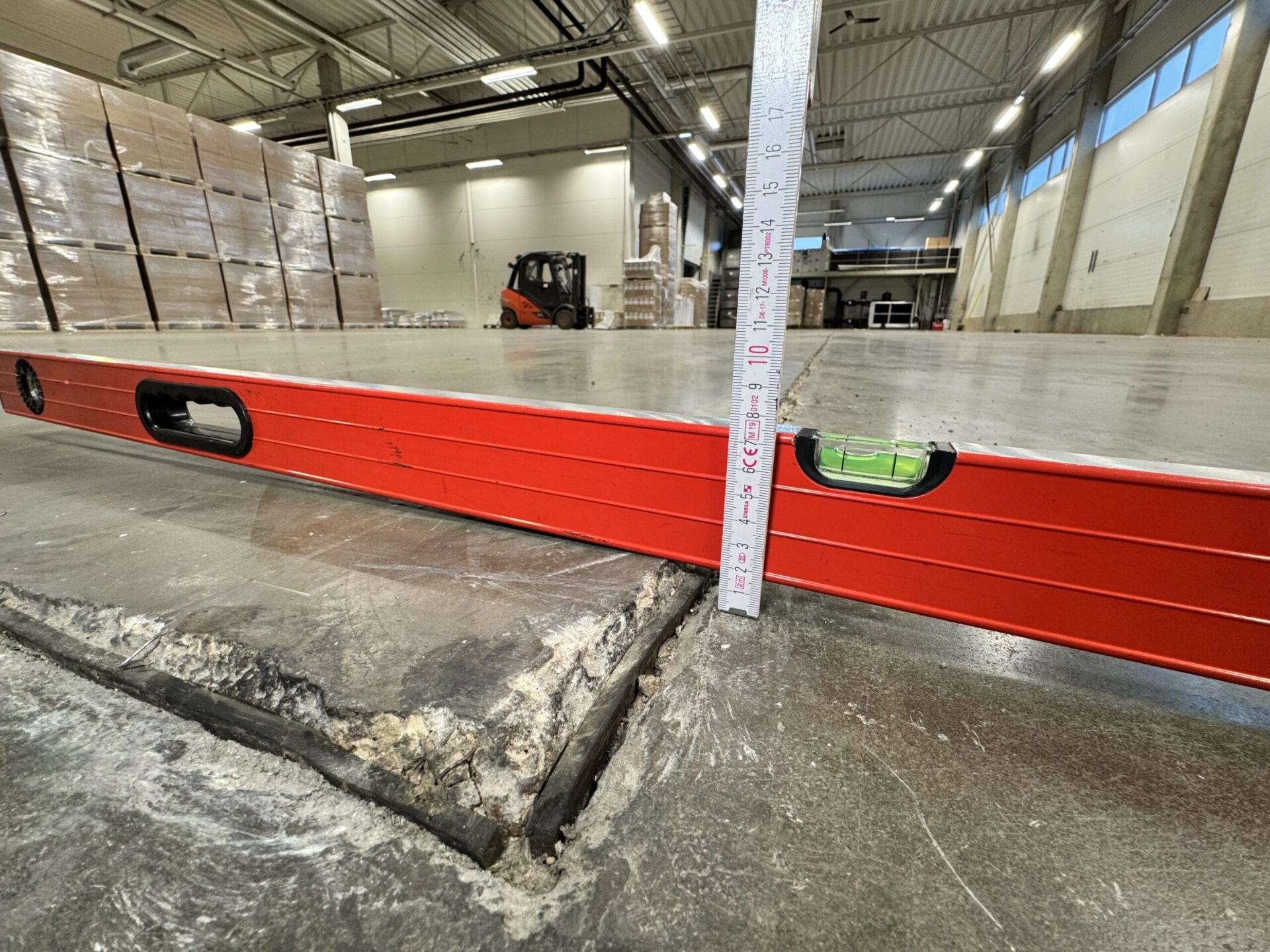
Floor settling is usually a slow and almost imperceptible process.
At first, it’s quite difficult to notice: chipping edges of the slabs, micro-cracks in the slab, vibrations felt when driving a forklift, or machinery that needs to be adjusted more frequently than before.
Most people assume these are simply the result of normal wear and tear, but they are actually warning signs that the subgrade beneath the slab is deforming.
The cause may be weak soil, natural soil conditions, design or construction errors, or water washing away the soil beneath the floor.
When the cause is ignored, the damage usually worsens.
The slab may continue to deform. Cracks may widen. Level differences may increase. A minor unevenness can become a wider area of movement, and in the worst case, the slab collapses to the point where further use becomes impossible. What began as a maintenance issue can become an operational problem.
In such cases, forklift speeds are reduced, operating costs increase, restrictions are imposed, and changes to cargo movement are required. Automated lines come to a halt, frequent recalibration is needed, and downtime generates losses. At a furniture factory near Tartu, Estonia, floor settlement caused equipment to tilt, sensors to become misaligned, and the production line to stop. Until the foundation was stabilized and reinforced, the line would stop and had to be calibrated every two weeks.
This is a real problem: reduced operational efficiency, increased operating costs, production line stoppages due to misalignment, and product breakage.
In warehouses and logistics centers, uneven floor slabs cause a different chain of problems. Forklift speeds are reduced. Loading routes become less efficient. This can affect rack stability and workplace safety. When using heavy equipment, pallets, and performing repetitive movements, even the slightest differences in height cause problems. Therefore, the tolerance for floor levelness is very low here.
For property owners, floor settlement can become a problem because the tenant files a complaint. Uneven floors, cracks, dust-generating repair work, and recurring defects necessitate corrective action. In the case of repairing a sunken floor in a shopping center, traditional repair methods—which involved dismantling the floor, compacting the subfloor, and re-pouring concrete—led to tenant complaints and claims regarding damage to goods caused by dust. In subsequent stages, using Geolift technology, the structures were raised without interrupting operations and without generating dust.
In the worst-case scenario, floor and subfloor problems can escalate from mere inconveniences to a complete halt in operations. When these issues remain unresolved, it becomes impossible to conduct business safely or practically in some buildings.
The conclusion is simple: don’t wait until the floors become unusable.
Ask the right questions at the right time:
- What caused the movement?
- Is the problem in the concrete or beneath it?
- Are there voids, weak soil, water damage, or load-bearing issues?
- Is the deformation still ongoing or getting worse?
- Is it possible to stabilize the soil before major repairs are needed?
“GEOLIFT” follows this sequence: first, the cause is identified, then the technology is selected. “GEOLIFT” is capable of stabilizing the soil, filling voids, and raising the floor to its original position without the usual excavation.
A sunken floor is not just a surface defect. It is usually the first sign of a deeper problem.
Early technical assessment and GEOLIFT technology can help prevent minor deformation from turning into major repairs, prolonged downtime, or a complete shutdown of operations.