

Buildings rarely announce settlement with one dramatic failure. More often, the early warnings are quiet: a diagonal crack that was not there last season, a door that suddenly sticks, a floor that feels slightly wrong underfoot. That pattern matters.
From a ground-engineering perspective, the key issue is not the crack itself. It is the mechanism behind it. When soil weakens, washes out, shrinks, settles, or was never properly compacted in the first place, the structure above starts redistributing stress. That is why the smartest response is not cosmetic first. It is diagnostic first. GEOLIFT frames the problem the same way: stabilise the soil and deal with the cause, not only the visible effect.
1. Diagonal or stair-step cracks, especially near doors and windows

This is often the first sign owners notice. In masonry and other brittle finishes, settlement-related cracking commonly appears as diagonal cracks from the corners of doors and windows, or as stair-step cracks following mortar joints. Engineering sources explain why: openings are stress concentrators, so when part of a building moves differently from another part, those corners become vulnerable locations for crack formation.
The important distinction is not simply “crack or no crack.” It is whether the crack is widening, returning after repair, appearing on both the interior and exterior, or accompanied by other symptoms. A crack that keeps coming back after patching is often telling you the building is still moving. In practice, that is where superficial repairs become expensive: they improve appearance briefly, but they do not restore support beneath the structure.
2. Doors and windows that suddenly stick, jam, or fall out of square

Many owners notice this before they recognise settlement as a structural issue. A door that used to close cleanly but now rubs the frame, or a window that suddenly resists opening, can be a serviceability warning that the opening has distorted because the building is moving unevenly. Differential settlement is specifically associated with doors and windows that no longer operate properly.
This sign matters because it is functional, not just visual. People often tolerate a crack for months, but a front door that jams or an internal door that will not latch is harder to ignore. From a diagnostic standpoint, that makes sticking openings especially valuable: they often confirm that the movement is affecting geometry, not only finishes.
3. Floors that slope, sink, crack, or feel uneven

Uneven floors are one of the clearest signs that support conditions beneath a building may have changed. Sloping floors, cracked slabs, sinking concrete, and gaps between floors and skirting boards are common indicators of subsidence or an unlevel structure. In some cases, poorly compacted fill can lead to floor settlement and cracking in interior walls.
This sign is particularly important in slab-on-grade buildings and in structures built over fill. When a fill layer consolidates, erodes, or was inadequately compacted, the floor may begin to settle before the owner fully understands the cause. That is why ground history matters: what was placed beneath the slab, how it was compacted, how water moves around the site, and whether leaks or voids are present.
4. Gaps opening where building elements used to meet cleanly

Settlement is not always dramatic cracking. Sometimes it shows up as separation. Common examples include gaps under skirting boards, around cornices and architraves, between floors and walls, or at the junction between an extension and the main building. Those small separations matter because they suggest that different parts of the structure are no longer moving together.
This is one reason experienced ground engineers do not look at a single defect in isolation. A narrow crack plus a sticking door plus a new trim gap is a more meaningful pattern than any one symptom on its own. The building is effectively giving you a movement map; the task is to read it before the distortion becomes more expensive to correct.
5. The clues outside the building

Some of the most useful warning signs are outside. Cracks in paths, patios, or driveways; ponding water where it did not collect before; changes near drains; leaning external features; or movement in surrounding hardscape can all point to ground instability rather than a purely internal finish problem.
We can also link settlement with moisture changes, erosion, damaged underground services, poorly compacted fill, tree-root effects, nearby excavation, and unstable ground. This matters because the mechanism is often environmental or geotechnical. In shrinkable soils, vegetation and seasonal drying can reduce support. In other cases, leaking drains or buried services wash fines out of the soil and create voids. Elsewhere, the issue is simply that the original ground or fill never had the density or bearing performance the building needed. The visible symptom may be in the wall, but the trigger is usually in the ground.
What many owners get wrong
The most common mistake is treating settlement as a decorating problem. Replastering, repainting, or re-sealing joints can make a room look better, but it does not answer the only question that matters: is the building still moving, and why? Research on crack-pattern diagnosis in masonry makes the same point in more technical language: the interpretation of crack patterns and discontinuities is critical to assessing risk correctly.
A second mistake is overreacting to one isolated defect. Not every crack is evidence of serious settlement, and not every imperfect floor is a structural emergency. What raises concern is progression and combination: cracks that grow, doors that distort, floors that slope more noticeably, or multiple symptoms appearing in the same zone of a building. That is when a proper assessment becomes necessary.

What to do next
Start by documenting what you see. Take dated photographs, note where cracks start and end, and record whether doors, windows, or floors are changing over time. Then look beyond the finishes: drainage, buried services, nearby excavation, fill history, soil conditions, and whether the affected area lines up with a known weak point.
When unstable or weak ground is confirmed as the mechanism, the repair strategy should restore support below the structure, not merely hide the symptoms above it. That is where modern ground-improvement methods, including geopolymer injection in suitable cases, have changed the conversation.
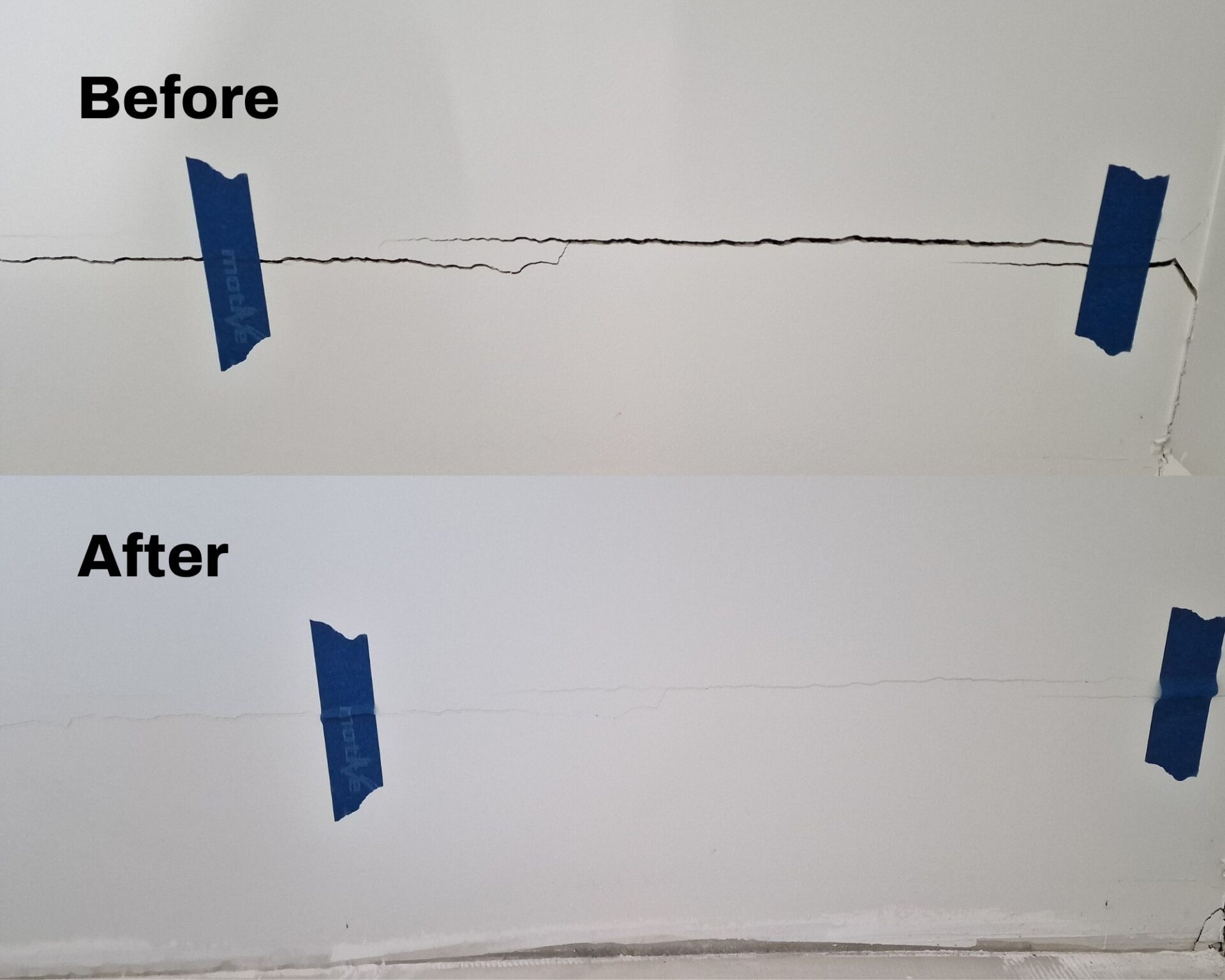
GEOLIFT positions geopolymer injection as a way to stabilise soil and lift or level floors and foundations by addressing the unstable soil itself.
The practical takeaway is simple: early signs are valuable only if you act on them correctly. Buildings do not settle because plaster is weak. They settle because support changes. Read the warning signs early, investigate the ground, and choose a solution that treats the cause rather than chasing the symptoms.